Good to see you
Welcome to Dulux Trade
Terms and Conditions
Thanks! for registering
Successfully registered, please login
Registration complete
Forgotten your password?
Please enter email address associated to your account
Change Password
Password changed successfully.
Request sent!
Would you spare a minute to answer 3 questions
Registration complete
Successfully registered, please login
Delete Account
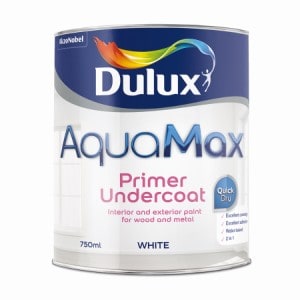
AquaMax Water-Based Primer Undercoat
-
Excellent coverage
-
Smooth application
-
Water based
-
Interior and exterior
-
Finish N/A
-
Coverage A guide to the practical coverage which can be achieved under normal conditions is up to 13m² per litre.
-
Drying Time 1-2 hours
-
Recoatable 2-4 hours
-
Thinning Sealing new or bare surfaces- Add up to 1 part clean water to 10 parts paint. Normal use (not to be exceeded)- Add up to 1-part clean water to 10 parts paint. Conventional spray application- Add up to 1-partclean water to 2.5 parts paint. Airless spray application- Add up to 1-part clean water to 5 parts paint
-
EASY TO APPLY
-
WATER BASED, LOW ODOUR
-
UNDERCOAT
Product Description
Application Description
Technical & Safety Documentation
Colour Range
Tips & Advice
-
1. Preparing the SurfacesTo get the best results, ensure surfaces to be painted are sound, clean, and dry (new surfaces particularly must be fully dry) and free from all defective or poorly adhering material such as dirt, grease, or wax.
Thoroughly rub down previously painted surfaces, using ‘wet flatting’ methods where possible, then wipe off with a damp, lint free cloth. Special precautions should be taken during surface preparation of pre-1960s paint surfaces over wood and metal as they may contain harmful lead.Treat any knots in wood with an appropriate knotting solution. Any surface defects should be filled with the appropriate Polycell product. -
2. After useCleaning After Final Use- Cleaning your brushes and rollers immediately after their final use ensures they can be reused for multiple projects, saving you money and reducing waste. Cleaning- 1. Remove Excess Paint- Scrape off excess paint into container for future projects. 2. Clean with Warm, Soapy Water- Use warm, soapy water in a sealed container, such as a bucket or empty tub, to clean your brushes and rollers. 3. Rinse Thoroughly- Ensure all soap and paint residues are completely rinsed out into container. 4. Dry Naturally- Allow brushes and rollers to dry naturally and store them in a dry, dust-free place. 5. Allowing solids to settle- Allow the paint solids to settle at the bottom of the container. Once settled, pour the clear water into another container for reuse or disposal. 6. Responsible Disposal- Let the remaining paint solids dry out completely and dispose of them as solid waste. Do not flush paint down the drain, including when cleaning painting tools
-
3. StoringStoring & Responsible Disposal- Do not use or store paint in extreme temperatures and protect from damp & frost. Reuse, Recycle, or Donate- Whenever possible, reuse, recycle, or donate leftover paint. Find local services at mywaste.ie or consider advertising paint locally—many good causes need it to brighten community spaces. Dispose Responsibly- Never pour paint or wastewater down drains or sinks. Follow instructions at mywaste.ie to recycle empty packs. Reuse Roller Cages- Remove sleeves and store cages in a dry, dust-free place. Dispose of Unusable Brushes and Sleeves- If brushes or sleeves cannot be cleaned or reused, dispose of them in general waste to avoid recycling issues. Paint Wash Water- Collect wash water in a container; don’t pour it into drains or on the ground. Let solids settle, pour off clear water for reuse or disposal, and let solids dry before disposing as solid waste. Do not flush paint down drains, including when cleaning tools.
How much paint do I need?
More than one wall to paint? Try our advanced paint calculator
Measure the height and length of the surface you want to paint (in metres or centimetres).

Your Measurements:
{{!-- This value will be injected with JavaScript --}}
Amount needed:
{{!-- This value will be injected with JavaScript --}}
Actual coverage will depend on the conditions of the surface. If the colour change is strong, more coats may be required.
Add a new job
Add a new job
Edit job
Delete job
Are you sure? All notes, photos and saved items will be deleted.
Save Color
Save to My Workspace
Add to job

AquaMax Water-Based Primer Undercoat
Save to My Workspace