Good to see you
Welcome to Dulux Trade
Terms and Conditions
Thanks! for registering
Successfully registered, please login
Registration complete
Forgotten your password?
Please enter email address associated to your account
Change Password
Password changed successfully.
Request sent!
Would you spare a minute to answer 3 questions
Registration complete
Successfully registered, please login
Delete Account
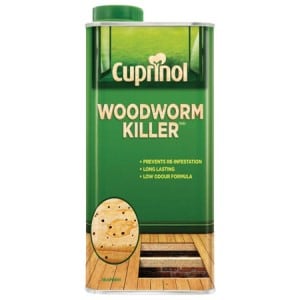
Cuprinol Woodworm Killer (WB)
-
Kills wood-boring beetle larvae
-
Deep penetration ensures effective protection for years to come
-
Prevents re-infestation
-
Finish N/A
-
Coverage Coverage can vary depending on application method and the condition and nature of the surface
-
Composition Water-based
-
WATER BASED, LOW ODOUR
-
LONG LASTING
Product Description
This low odour, water based formula has been specially developed to make it more pleasant and convenient to use.
Application Description
Polished Wood: Inject into flight holes 5-7cm (2-3ins) apart. Flood into joints. Wipe off surplus. In severe cases repeat treatment. Fluid does not penetrate polished surfaces. Wax polished surfaces will normally require re-waxing after treatment.
Note: The application of this product may cause darkening of some timbers. If colour is critical, try a test area first and allow to dry fully to ensure final appearance is acceptable. After drying, glues, fillers and knotting can be used normally. Bitumen, rubber and some plastic based materials may soften or swell on contact with fluid or solvent vapour.
Technical & Safety Documentation
Tips & Advice
-
1. Preparing the SurfacesEradication is best achieved if the wood is bare, dry and clean. Wood that has been woodstained, painted, or varnished should be stripped back to bare wood and treated as bare wood. When treating roof joists, first remove insulation and do not relay for at least 36 hours or until treatment is dry. Remove insulation and protect electrical sockets, fuse boxes, etc. Do not use on antique furniture or other water sensitive items.
-
2. After useCleaning After Final Use- Cleaning your brushes and rollers immediately after their final use ensures they can be reused for multiple projects, saving you money and reducing waste. Cleaning- 1. Remove Excess Paint- Scrape off excess paint into container for future projects. 2. Clean with Warm, Soapy Water- Use warm, soapy water in a sealed container, such as a bucket or empty tub, to clean your brushes and rollers. 3. Rinse Thoroughly- Ensure all soap and paint residues are completely rinsed out into container. 4. Dry Naturally- Allow brushes and rollers to dry naturally and store them in a dry, dust-free place. 5. Allowing solids to settle- Allow the paint solids to settle at the bottom of the container. Once settled, pour the clear water into another container for reuse or disposal. 6. Responsible Disposal- Let the remaining paint solids dry out completely and dispose of them as solid waste. Do not flush paint down the drain, including when cleaning painting tools
-
3. StoringStoring & Responsible Disposal- Do not use or store paint in extreme temperatures and protect from damp & frost. Reuse, Recycle, or Donate- Whenever possible, reuse, recycle, or donate leftover paint. Find local services at mywaste.ie or consider advertising paint locally—many good causes need it to brighten community spaces. Dispose Responsibly- Never pour paint or wastewater down drains or sinks. Follow instructions at mywaste.ie to recycle empty packs. Reuse Roller Cages- Remove sleeves and store cages in a dry, dust-free place. Dispose of Unusable Brushes and Sleeves- If brushes or sleeves cannot be cleaned or reused, dispose of them in general waste to avoid recycling issues. Paint Wash Water- Collect wash water in a container; don’t pour it into drains or on the ground. Let solids settle, pour off clear water for reuse or disposal, and let solids dry before disposing as solid waste. Do not flush paint down drains, including when cleaning tools.
How much paint do I need?
More than one wall to paint? Try our advanced paint calculator
Measure the height and length of the surface you want to paint (in metres or centimetres).

Your Measurements:
{{!-- This value will be injected with JavaScript --}}
Amount needed:
{{!-- This value will be injected with JavaScript --}}
Actual coverage will depend on the conditions of the surface. If the colour change is strong, more coats may be required.
Add a new job
Add a new job
Edit job
Delete job
Are you sure? All notes, photos and saved items will be deleted.
Save Color
Save to My Workspace
Add to job

Cuprinol Woodworm Killer (WB)
Save to My Workspace